Every gardening writer likes to write about reading seed catalogs as the midwinter snow falls.
So I won't do that. I will just mention that I was perusing the new
Richter's catalog as
ten inches of fresh powder--well, OK, it is more than a cliche. It happens.
"What the hell," I said. "They're selling
goatheads!" Also called puncturevine.
Tribulus terrestis. Nasty, invasive, spreading Eurasian weeds whose multi-pointed seed capsules can bring a dog to a whimpering standstill, not to mention being hard on bicycle inner tubes.
M.'s response was to pass me a copy of Charles W. Kane's
Herbal Medicine of the American Southwest, which she had just brought home from the Pueblo library. (We may have to buy it.) She held it open to the section on puncturevine.
It turns out to be helpful for moderate hypertension, to increase male libido (herbal Viagra?), and to contain some natural steroids.
Many men using the plant often notice a related sense of increased physical strength and will -- a good tonic for older men and the metrosexual alike.I consider
Michael Moore (not the filmmaker) to be one of the best Southwestern herbalists.
He contributed the foreword, noting, "
Charles has written an impeccable book."
Here is Kane's border-country spin on the usual herbalists' advice on wildcrafting--gathering plants in the wild:
Collect away from roadsides, inner city areas, industrial sites, agricultural areas, and heavily traveled foot trails -- explaining yourself to every busy-body hiker gets to be tiresome, although visibly packin' heat usually limits conversation to furtive glances.Although a short drive takes us to eastern Fremont County, Colorado, which is sort of the last outlier of the Chihuahuan Desert, a lot of Kane's plants are hundreds of miles away. But about half of them are here.
Methods of preparation are clearly described, and the plants are illustrated with color photos and Frank Rose's meticulous botanical paintings.
If you live in the Southwest and you like to take care of some minor ills yourself or learn some herbal first aid, you should have it.
(Cross-posted to
Nature Blog.)
Labels: herbalism
 is sort of like the wort-cunning herbalist witch archetype, only with (Asian) Indians and a Bollywood star whose "acting" is very stylized, mostly about eye makeup.
 .
.

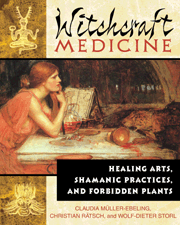 The book is more a study of cultural transformation using texts and art work. The three "explore the demonization of nature's healing powers and sensuousness, the legacy of Hecate, the sorceress as shaman, and the plants associated with witches," to quote the back-cover blurb.